


Learning & Participation
STUDENT ART ARCHIVE (BRAZIL)
As part the workshops, local artists guided participants in exploring their personal connections to the theme It’s Not Easy Being Green helping them draw out ideas and emotions and translate these into art.
Each school approached the work differently: some collaborated on large, co-created pieces, while others developed individual concepts that were later incorporated into the final billboard artworks. Here you can see a selection of pieces created by the young people during the workshop process.
Untitled, 2026
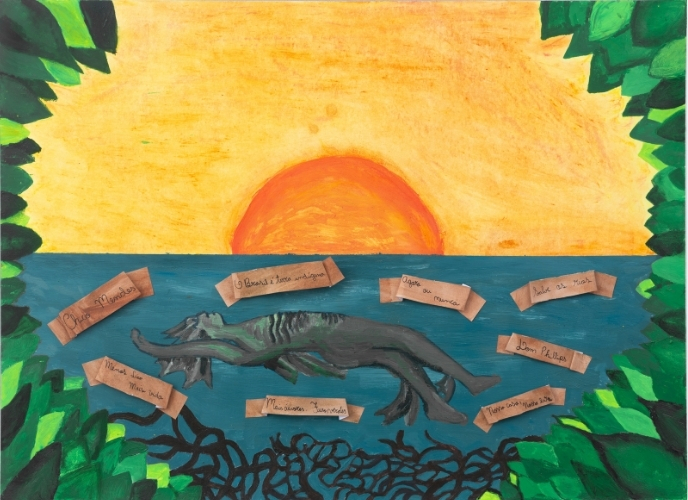
The work is structured around the figure of Caboclo d’Água, an entity from popular imagination associated with rivers, lakes and springs, guardian of the waters and the beings that depend on them. Represented in the centre, he emerges as a hybrid body between human and nature, symbolising the vital force of rivers and the ancestral relationship between communities and territory.
Around him are powerful phrases and collective desires: ‘Brazil is indigenous land,’ ‘Now or never,’ ‘Save the rivers,’ ‘Our home, our struggle,’ ‘Less waste, more life,’ “More trees. Green future.” These phrases transform the work into a space for activism, words that function as voices that transcend time, connecting the enchanted to contemporary struggles for environmental preservation and the rights of indigenous peoples.
Among these voices are the names of Chico Mendes and Dom Phillips, figures who symbolise the defence of the Amazon on different fronts. Chico Mendes, rubber tapper and environmental leader, became an international reference in the fight for forest preservation and the rights of indigenous peoples. Dom Phillips, a British journalist, dedicated his work to exposing environmental crimes and violations in the Amazon, and was murdered while investigating these issues. Both represent the commitment, risk and sacrifice involved in defending the forest and its peoples.
Thus, by bringing together Caboclo d’Água, the manifesto phrases and these names, the work transforms the river into a space of memory, struggle and hope, where myth, history and activism come together to affirm the urgency of caring for water, land and life.
School: Colégio Notre Dame Ipanema
Artist: Marcela Cantuária
Untitled, 2026
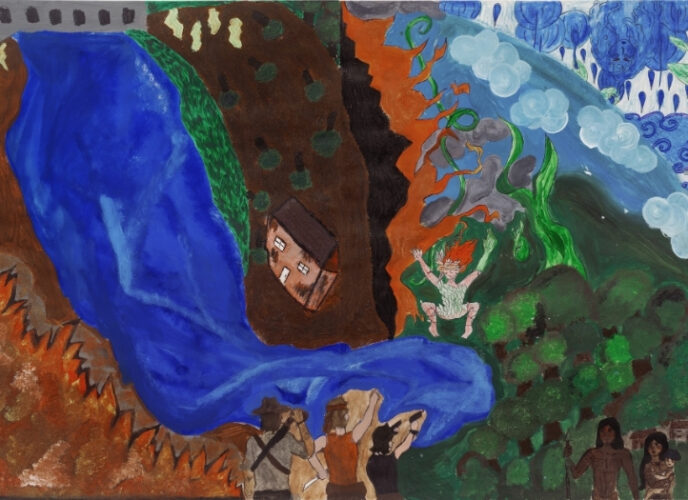
The scene is staged as a battleground, where forces of destruction and preservation clash. Curupira, guardian of the forest [a prominent, ancient figure in Brazilian Indigenous (Tupí-Guaraní) folklore] with his feet turned backwards, appears as a watchful and protective presence against the predatory actions symbolised by the armed men in the centre.
In contrast, the indigenous family affirms the permanence of the native peoples and their ancestral relationship with the land, while the spiritual female figure, linked to rain, announces regeneration and the continuity of life. By bringing together folklore, nature and human figures, the work offers a critical reading of violence against the forest and the persistence of the forces that protect it.
School: Colégio Estadual Ignácio Azevedo do Amaral
Artist: Marcela Cantuária
Untitled , 2026
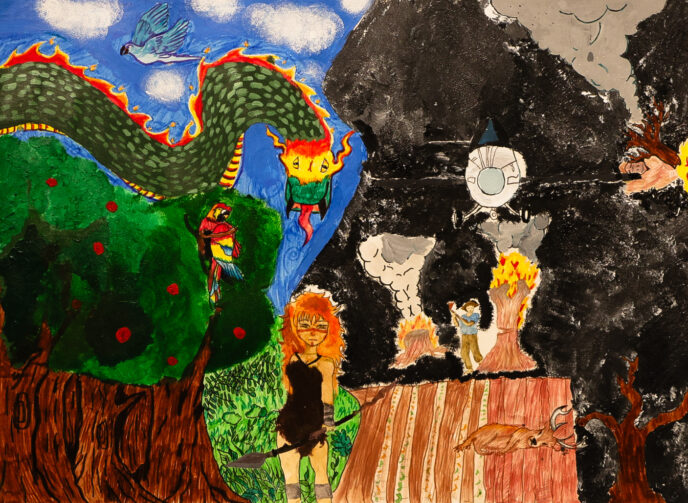
The work articulates Brazilian folklore as a tool for environmental denunciation. At the centre of the composition is Caipora, a protective entity of the forest, known for confusing hunters and punishing those who disrespect animals and the forest. Her presence affirms the idea of vigilance and resistance in the face of exploitation of the territory. In the sky, the Boitatá Snake appears, a fire serpent from Brazilian mythology associated with the protection of nature and punishment for burning and destroying the forest. On the left, life still resists with trees, rivers and macaws, including the blue macaw, an endangered species. In contrast, on the right, the aeroplane cutting through the sky signals human encroachment, accompanied by a scene of deforestation, fire and death.
By bringing together enchanted beings, fauna and machines, the work offers a direct critique of environmental devastation, evoking folklore as ancestral memory and a warning: the forest is not empty, it is inhabited by lives, stories and guardians.
School: Colégio Estadual Ignácio Azevedo do Amaral
Artist: Marcela Cantuária
Untitled, 2026
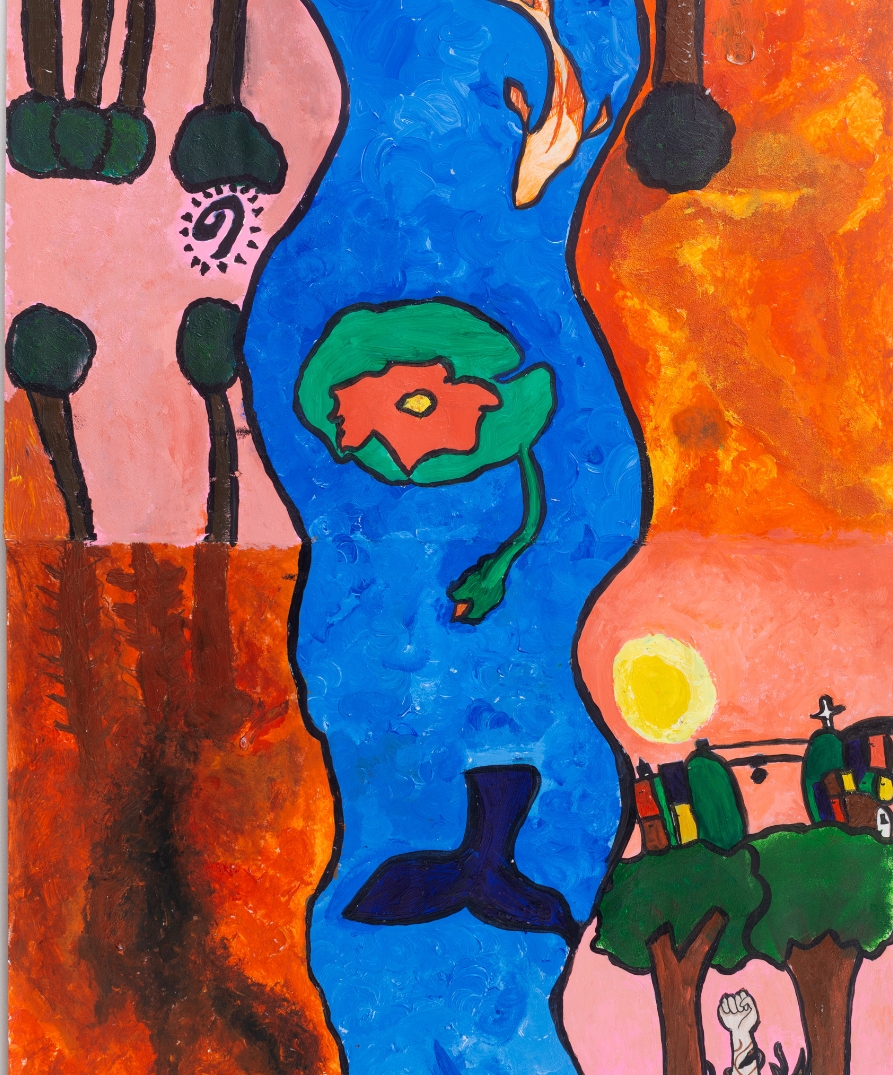
The work is built around the flow of a river, which runs through the composition as an axis of life and, and at the same time, of conflict. In the centre, the waters welcome figures and shapes that evoke the enchanted beings of traditional folklore. On the left and right, the river is compressed by tense landscapes: the use of intense colours refers to fire, damaged land and the marks of human intervention, in contrast to small pockets of resistance, where trees, houses and gestures of struggle still persist. The composition highlights the river as a space of struggle, memory and survival, revealing the fragility of the territories and the urgency of their preservation.